

Last Updated: April 2026 | By the HomeschoolPicks Team (15+ years combined homeschooling experience across three families)
Affiliate Disclosure: This article contains affiliate links. If you purchase through our links, we may earn a small commission at no extra cost to you. We only recommend resources we’ve personally used or carefully vetted.
When I first stumbled across the Charlotte Mason method eight years ago, my oldest was six, glazed over at a worksheet, and I was exhausted. A friend handed me a battered copy of For the Children’s Sake and said, “Read this before you buy another curriculum.” Three chapters in, I was crying happy tears. Someone had finally put words to the homeschool I wanted.
If you’ve landed here, you’re probably feeling that same pull. Maybe you’re tired of the workbook grind. Maybe you want your kids to actually love learning. Or maybe you just keep hearing “Charlotte Mason” in every homeschool group and you’re ready to find out what the fuss is about. This guide will walk you through everything, from the philosophy to your first week of lessons.
Quick Answer: What Is the Charlotte Mason Method?
TL;DR: The Charlotte Mason method is a gentle, literature-rich approach to education developed by British educator Charlotte Mason (1842-1923). It uses “living books” instead of textbooks, short focused lessons, narration instead of quizzes, and daily nature study to shape curious, thoughtful children. It works for all ages, costs little to start, and fits naturally into family life.
Who Was Charlotte Mason?
Charlotte Mason was a British educator who believed every child deserved a generous, beautiful education, not just the wealthy ones. She ran a teacher training college in Ambleside, England, and wrote a six-volume home education series that’s still in print today. Her core motto: “Education is an atmosphere, a discipline, a life.”
Mason rejected the industrial-school model of her era. She didn’t want children treated like empty buckets to be filled with facts. She wanted them treated as born persons, already full of ideas, worthy of great literature, art, music, and time outdoors. A century later, her ideas feel more revolutionary than ever, especially for burned-out homeschool families.
The Core Principles of the Charlotte Mason Method
Mason laid out 20 principles, but for beginners, six do most of the heavy lifting. Master these and you’ve got the heart of the method.
1. Living Books Over Textbooks
A living book is written by one passionate author who knows their subject and writes with warmth and narrative power. Think Charlotte’s Web, The Burgess Bird Book, or a well-written biography of Abraham Lincoln. Textbooks, by contrast, are usually written by committee, chopped into boring bites, and forgotten the day after the test.
Mason believed ideas are the food of the mind, and living books are where ideas live. You can check out the Ambleside Online booklist for thousands of vetted living book suggestions by grade level.
2. Short Lessons
Here’s the rule that sold me: lessons should be short. Really short. For a 6-year-old, 10 minutes of math is plenty. For a 10-year-old, 20 minutes. Mason argued that children learn better when they give full attention for a short burst than when they slog through an hour of half-focused work.
When we switched to short lessons, my kids went from fighting me at the table to finishing their morning work in under two hours. The secret wasn’t pushing harder; it was respecting their attention span.

3. Narration Instead of Tests
After reading a passage, the child tells it back in their own words. That’s narration. It sounds too simple to work, but it’s surprisingly rigorous. To narrate well, a child has to pay attention, hold the ideas, organize them, and put them into their own sentences. Try it yourself sometime, it’s harder than a multiple-choice test.
Oral narration starts around age 6. Written narration begins around age 10. Both replace most of the worksheets and quizzes you’d see in traditional schooling.
4. Nature Study
Every week, Mason’s students spent significant time outdoors observing the natural world. They kept nature notebooks with drawings, field notes, and observations. This isn’t just fresh air, it’s a science curriculum. Research from the North American Association for Environmental Education shows that regular outdoor learning improves focus, critical thinking, and academic outcomes across subjects.
5. Habit Training
Mason said a good education lays down “tramlines” of good habits that carry a child through life. Attention, obedience, truthfulness, neatness, punctuality, these are the real curriculum in the early years. Skills come and go. Habits stay.
6. Masterly Inactivity
Perhaps Mason’s most countercultural idea: children need unstructured time. Lots of it. Hours to play, imagine, and get bored. Parents should be present but not directing every moment. This is how creativity and inner discipline actually grow.
What a Charlotte Mason Day Looks Like
Here’s a sample morning for a family with a 7-year-old and a 10-year-old. Your mileage will vary, but this gives you the shape.
| Time | Activity | Duration |
|---|---|---|
| 8:30 | Morning basket (Bible, poetry, hymn, prayer) | 20 min |
| 8:50 | Math (separate for each child) | 15-20 min |
| 9:15 | Copywork or handwriting | 10 min |
| 9:25 | Short break / snack | 10 min |
| 9:35 | Reading aloud + narration (history or literature) | 20 min |
| 9:55 | Geography or picture study | 15 min |
| 10:10 | Nature walk / free play outdoors | 60+ min |
Most Charlotte Mason families wrap formal lessons by lunchtime and spend afternoons on handicrafts, free reading, music, and more outdoor time. It’s genuinely doable, even with toddlers underfoot.
Benefits of the Charlotte Mason Method
- Builds lifelong readers. Kids raised on living books genuinely love books.
- Works for all learning styles. Auditory, visual, kinesthetic, it meets them all.
- Affordable. Your library card is the main supply list.
- Gentle on sensitive kids. No timed tests, no red ink, no shame.
- Forms character. Habit training does real work over the long haul.
- Sustainable for parents. Short lessons mean you’re not facilitating school for eight hours a day.
A 2022 peer-reviewed study indexed through ERIC (U.S. Department of Education) found that homeschool students using literature-based approaches scored in the 80th percentile or higher on standardized reading assessments, well above national averages. That squares with what Charlotte Mason families report anecdotally year after year.
Challenges of the Charlotte Mason Method
I’d be doing you a disservice if I only listed the pros. Here’s what’s hard about this approach.
- It’s parent-intensive. You can’t hand a CM curriculum to a 7-year-old and walk away. Expect to be present for most lessons.
- No scripted plans (usually). You’ll make choices about booklists, scheduling, and pacing. Some parents love this; others feel lost.
- Narration takes practice. Both you and your child will struggle at first. Give it six weeks.
- The community can feel purist. You’ll meet families who insist on doing things “the Charlotte Mason way.” Ignore them. Mason herself was practical.
- Record keeping looks different. If your state requires detailed logs, you’ll need a system. A simple daily journal works fine.
Best Practices for Getting Started
Start Small, Start This Week
Don’t overhaul everything. Pick one practice and try it for two weeks: read a great book aloud and ask your child to narrate. That’s it. See how it feels. Build from there.
Read One Primary Source
Before spending a dime on curriculum, read When Children Love to Learn (edited by Elaine Cooper) or A Charlotte Mason Companion by Karen Andreola. Both are gentle on-ramps. Later, dip into Mason’s own Home Education (it’s free online).
Use Your Library
Your first “curriculum” should be a stack of library books. You don’t need to buy anything in year one. Request living books from Ambleside Online’s free curriculum through interlibrary loan.
Schedule Nature Time Like an Appointment
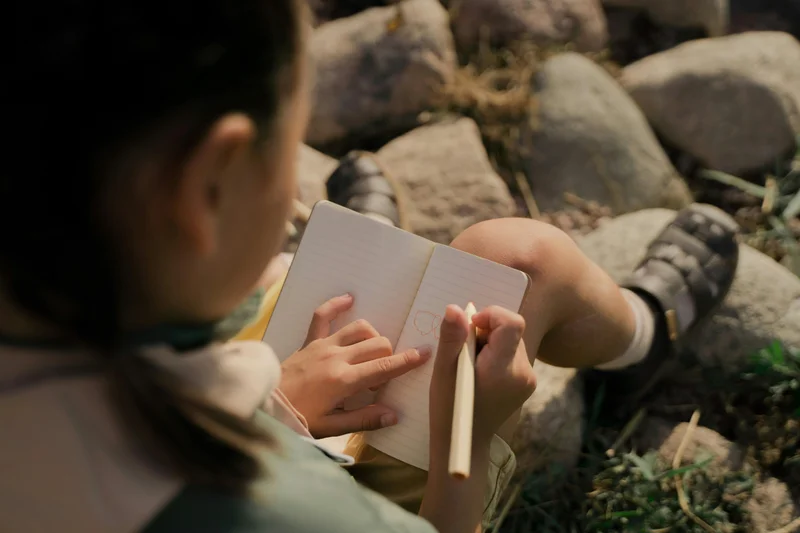
If you don’t schedule it, it won’t happen. Put “nature walk” on the calendar three times a week, rain or shine. A simple sketchbook and a pencil are all you need to start.
Keep a Term Plan, Not a Year Plan
Mason organized her schools into 12-week terms. That’s enough planning ahead without locking you into September’s choices all the way through May. At the end of each term, take a week off and reassess.
Scope of the Charlotte Mason Method
Charlotte Mason isn’t just “for little kids.” Her approach scales from preschool through high school, though it looks different at each stage.
- Ages 0-6 (early years): Mostly outdoor play, read-alouds, and habit training. No formal academics.
- Ages 6-9 (Form 1): Short lessons begin. Oral narration, copywork, basic math, picture study.
- Ages 9-12 (Form 2): Written narration starts. More history, geography, multiple foreign languages, broader literature.
- Ages 12-15 (Form 3-4): Deeper studies in all subjects. Essay writing, primary sources, serious science.
- Ages 15-18 (Form 5-6): Essentially a classical liberal arts education. Plenty of graduates go straight to strong universities.
Disadvantages You Should Consider Honestly
Charlotte Mason isn’t for everyone. If you want a completely open-and-go box curriculum with no thinking required, the Charlotte Mason method will frustrate you. If your child thrives on gamified apps and quick feedback, they may resist narration. And if you personally hate reading aloud, pick a different method, that’s non-negotiable here.
Also, this approach can feel slow. You won’t see the same kind of weekly “test score” progress a workbook gives you. The results show up over years, not weeks. Parents who need frequent reassurance may struggle with the trust this approach requires. The HSLDA overview of the Charlotte Mason method offers a balanced look at the trade-offs before you commit.
Practical Summary: Your First 30 Days
- Week 1: Read For the Children’s Sake by Susan Schaeffer Macaulay. Take notes on what resonates.
- Week 2: Start a daily 20-minute read-aloud. Ask for oral narration afterward. Don’t correct, just listen.
- Week 3: Add a nature walk three times a week. Bring a sketchbook. Draw one thing you see.
- Week 4: Introduce a morning basket: a short Bible reading, a poem, and one hymn or folk song. Ten minutes total.
That’s it. By day 30 you’ll have done more Charlotte Mason than many families do in a year, and you’ll know if this approach fits your family.
Charlotte Mason vs Other Methods
| Method | Main Tools | Parent Time | Best For |
|---|---|---|---|
| Charlotte Mason | Living books, narration, nature | High | Literature-loving families |
| Classical | Trivium, Latin, logic | High | Rigor-focused families |
| Montessori | Hands-on materials, self-direction | Medium | Independent learners |
| Traditional | Textbooks, tests | Medium | Structure lovers |
| Unschooling | Child-led interests | Variable | Highly self-motivated kids |
Frequently Asked Questions
Is the Charlotte Mason method religious?
Mason herself was a devout Anglican, and her original schedule included Bible and hymn study. But the method itself, living books, narration, nature, short lessons, is secular-friendly. Ambleside Online is faith-based, while curricula like A Gentle Feast and Wildwood offer secular or flexible paths.
Can I combine Charlotte Mason with another method?
Absolutely. Many families do “CM-inspired” homeschools that borrow living books and nature study while using a workbook for math or a video curriculum for science. It’s not all-or-nothing.
How much does a Charlotte Mason homeschool cost?
You can do a full year for under a hundred dollars using library books and free resources like Ambleside Online. Premium curricula like Simply Charlotte Mason or A Gentle Feast run a couple hundred dollars per year per child, still affordable compared to most boxed programs.
Is the Charlotte Mason method rigorous enough for college prep?
Yes. Charlotte Mason graduates routinely attend selective colleges. The method’s emphasis on primary sources, essay writing, and wide reading is excellent preparation for college-level work. You’ll want to add standardized test prep in the high school years like any homeschool.
What ages does it work for?
Birth through graduation. The early years are mostly play and read-alouds. Formal lessons start around age six. High school uses the same method with more depth and independent work.
Final Thoughts
The Charlotte Mason method changed my family. Not because it’s magic, but because it gave us permission to slow down, read beautiful books, and trust that our kids were already curious humans who didn’t need to be force-fed facts. Eight years in, my oldest reads for pleasure, narrates plot twists at the dinner table, and has a nature notebook she’s genuinely proud of. I don’t think any workbook on earth could have done that.
If you’re just starting, don’t try to do everything at once. Pick one book to read aloud this week. Ask your child to tell it back. Go outside. That’s where the whole thing begins. You’ve got this, and you don’t need a perfect plan to start, you just need to start.
Ready to go deeper? Check out our guides on narration, nature study, living books, sample schedules, and habit training.




Leave a Reply