
This post may contain affiliate links. If you purchase through these links, we may earn a small commission at no extra cost to you. We only recommend products we genuinely believe will help your homeschool.
Finding the right chemistry program can feel hard. Labs, safety, and academic levels all add up. Many parents worry they can’t teach it at home. But here’s the good news: you can! The right program makes all the difference. I’ve taught chemistry to two of my kids, and we made it work.
We’ve spent years helping families pick science programs. After testing dozens of options, we’ve found the best picks. Do you need college prep? Or maybe a gentle intro for middle schoolers? Either way, this guide will help. For a broader view, check out our complete science curriculum guide.
Quick Answer: Our Top Picks
In short, here are our top chemistry curriculum recommendations:
- Best Overall: Apologia Chemistry – Thorough, well-structured, excellent lab component
- Best for College Prep: Novare Science – Rigorous mastery approach with strong math integration
- Best for Visual Learners: The 101 Series Chemistry – Video-based with engaging demonstrations
- Best for Middle School: Real Science 4 Kids Chemistry – Age-appropriate introduction
- Best Secular Option: CK-12 Chemistry – Free, flexible, comprehensive
What to Look for in a Homeschool Program
First, before diving in, know what makes a good program. Here are the key factors to consider:
Lab Component Quality
Chemistry is hands-on. Therefore, look for programs with real labs, not just demos. The best ones give clear instructions and safety rules. Additionally, they list supplies that work at home. Some programs add virtual labs too. As a result, these help with experiments too risky for home. For more options, see our hands-on science guide.
Math Prerequisites
What math does your student need? Most high school courses need Algebra 1 at minimum. Furthermore, Algebra 2 helps for honors-level work. The American Chemical Society says strong math leads to success. Therefore, check that your program lists its prereqs. In addition, good ones also provide math support in lessons.
Teaching Support
Unless you have a science background, you’ll want strong support. Look for lesson plans, answer keys with full explanations, and video options. In fact, I relied on videos when teaching chemistry. Many parents find videos essential for subjects outside their expertise.
Lab Safety Resources
Home lab work uses real chemicals. As a result, safety matters a lot. Good curricula cover safety well. For example, they list proper equipment, ventilation needs, and storage rules. Most importantly, they tell you which experiments need adult help. The U.S. Department of Education also stresses lab safety for home learners.
Top Programs for Homeschool
Below are our top picks, with detailed analysis of each program to help you decide which best fits your family.
1. Apologia – Best Overall
Apologia’s Exploring Creation series is the gold standard for homeschool science. In fact, we used it with both of our kids. It combines solid academic content with a Christian worldview. Consequently, for faith-based homeschools, it’s a top choice.
The curriculum uses a conversational style. In other words, it speaks directly to students. As a result, complex concepts become easy to grasp without being watered down. Each module builds step by step. Students master basic concepts before moving on. The lab program uses household items plus a separate kit. This keeps costs fair while giving real hands-on experience.
Pros:
- Conversational tone helps students learn independently
- Comprehensive lab program with detailed instructions
- Strong student and parent support community
- Video instruction available through Apologia Online Academy
- Proven track record with college admissions
Cons:
- Christian worldview integrated throughout (not suitable for secular families)
- Lab kit purchased separately adds to cost
- Some students find the conversational style too verbose
Best For: Christian homeschool families seeking a comprehensive, college-prep chemistry course with strong lab component.
Price: Textbook around $75; lab kit approximately $60-150 depending on vendor.
2. Novare Science – Best for College Prep
Novare Science uses a mastery-based approach that produces well-prepared students. Rather than covering topics once, Novare circles back throughout the year. As a result, this builds deep understanding, not surface knowledge.
The program stresses math more than most homeschool options. In fact, students learn not just what happens but why. Math models explain how molecules behave. Because of this, the approach helps students planning STEM careers. If you’re also looking at physics options, Novare offers that subject too.
Pros:
- Mastery approach builds deep, lasting understanding
- Strong mathematical integration prepares students for college chemistry
- Beautiful, professionally designed materials
- Excellent for students with strong math skills
Cons:
- Requires stronger math background than some alternatives
- Christian perspective woven throughout
- More challenging than average, may frustrate struggling students
- Fewer support resources than Apologia
Best For: Motivated students with strong math skills who want rigorous college preparation.
Price: Textbook around $45; teacher resource CD around $25.
3. The 101 Series – Best for Visual Learners
The 101 Series teaches through video, making it ideal for kids who learn by watching. The DVDs feature demos, animations, and clear talks. As a result, they bring molecular concepts to life.
This program works well when parents lack science confidence. Basically, the videos handle all instruction. Meanwhile, a guidebook provides schedules, worksheets, and tests. Students watch, take notes, do assignments, and try hands-on activities. In fact, my daughter loved the visual approach when she struggled with textbooks.
Pros:
- Video format ideal for visual and auditory learners
- No science background required for parents
- Engaging demonstrations make abstract concepts concrete
- Good introduction to chemistry fundamentals
Cons:
- Less rigorous than text-based alternatives
- Limited lab component
- May not satisfy honors-level requirements
- Christian perspective in presentation
Best For: Visual learners, parents lacking science background, students needing gentler introduction to chemistry.
Price: Complete set approximately $80-120.
4. Real Science 4 Kids – Best for Middle School
Real Science 4 Kids offers chemistry at multiple levels, making it perfect for introducing younger students to molecular concepts. The program presents real science in age-right language. Additionally, colorful pictures and fun experiments keep kids engaged.
The multilevel approach goes from elementary through pre-high school. Therefore, families can start chemistry earlier and build up naturally. Students learn chemical terms, lab steps, and scientific thinking. Consequently, this prepares them for rigorous high school chemistry later.
Pros:
- Age-appropriate presentation of real chemistry concepts
- Excellent experiment component using safe, household materials
- Worldview-neutral content works for any family
- Multiple levels provide natural progression
- Builds foundation for later high school chemistry
Cons:
- Not sufficient for high school credit as standalone
- Upper levels may not challenge advanced students
- Less community support than larger programs
Best For: Middle schoolers ready for real chemistry, families wanting secular options, students needing foundational preparation.
Price: Student text around $30; teacher manual around $25; lab workbook around $25.
5. CK-12 Chemistry – Best Free Secular Option
CK-12 provides free chemistry content through their FlexBook platform. The digital textbook covers all standard topics. Moreover, it includes interactive parts, practice problems, and tests.
This option appeals to secular homeschoolers wanting content without religion. Specifically, the practice system adapts to each student’s level and gives extra help where needed. Although it’s free, families should still budget for lab supplies. You may also need extra resources.
Pros:
- Completely free digital access
- Secular, fact-based presentation
- Interactive elements and adaptive practice
- Customizable content (teachers can edit FlexBooks)
- Regularly updated material
Cons:
- Requires supplemental lab program
- Digital-only format (no physical textbook option)
- Less structured for independent learners
- Parent must create or source assessments
Best For: Budget-conscious families, secular homeschoolers, families comfortable supplementing with lab resources.
Price: Free (budget for lab supplies separately).
Comparison Table: Programs at a Glance
| Curriculum | Grade Level | Approach | Worldview | Lab Included | Price Range |
|---|---|---|---|---|---|
| Apologia Chemistry | 10-12 | Textbook + Labs | Christian | Yes (kit separate) | $75-225 |
| Novare Chemistry | 10-12 | Mastery-based | Christian | Partial | $70-100 |
| Chemistry 101 | 9-12 | Video instruction | Christian | Limited | $80-120 |
| Real Science 4 Kids | 6-9 | Textbook + Labs | Secular | Yes | $55-80 |
| CK-12 Chemistry | 9-12 | Digital/Online | Secular | No | Free |
Setting Up Your Home Lab
Teaching chemistry at home means some lab prep. Below is how to create a safe home science space. For example, I set up our lab in the garage for better ventilation. The National Science Teachers Association also offers great safety guidelines.
Essential Safety Equipment
First, before conducting any experiments, ensure you have proper safety equipment:
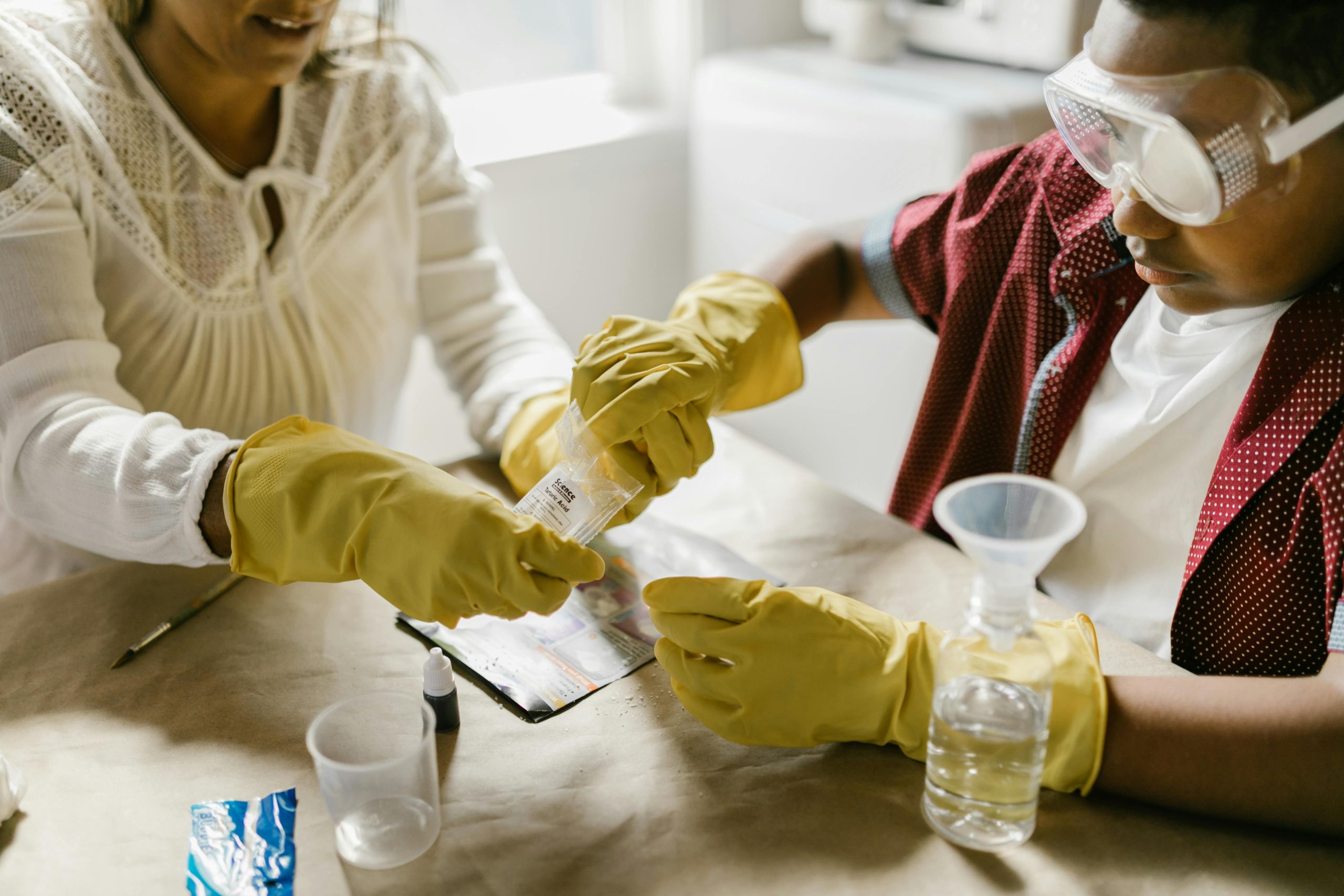
- Safety goggles (not just glasses) for each participant
- Chemical-resistant gloves appropriate for the chemicals used
- Fire extinguisher rated for chemical fires (Class B or ABC)
- First aid kit with eye wash solution
- Proper ventilation (outdoor or well-ventilated area for certain experiments)
Basic Lab Equipment
Most curricula provide specific supply lists. However, common items include:
- Beakers and graduated cylinders for measuring
- Test tubes and rack
- Bunsen burner or alcohol lamp (with adult supervision)
- Balance or digital scale
- Thermometer
- pH paper or pH meter
Chemical Storage
Store all chemicals the right way by keeping them away from children and pets. Also, keep chemicals that don’t mix well apart. Be sure to keep original labels on. Dispose of chemicals per local rules. Most homeschool curricula use safe chemicals. Still, proper storage remains key.
Online Resources to Supplement Your Program
In addition, these free resources can enhance any program:
- PhET Interactive Simulations from University of Colorado offers free virtual labs
- Khan Academy provides comprehensive video lessons at all levels
- Tyler DeWitt’s YouTube channel makes molecular concepts entertaining and accessible
- American Chemical Society offers free educational resources for students and teachers
Also, consider pairing your study with biology for a complete life science foundation.
Frequently Asked Questions
What grade should my child take chemistry?
Most students take chemistry in 10th or 11th grade, after finishing Algebra 1. Of course, timing varies based on math readiness. Some families go Biology-Chemistry-Physics, while others prefer Physics first. Ultimately, what works best depends on your student’s math level and interests.
Can I teach chemistry without a science background?
Yes! Programs like Apologia and the 101 Series work for parents to learn with students. For example, videos, detailed guides, and support groups help you learn as you teach. Many homeschool parents teach subjects they never studied. Honestly, I did it, and you can too.
Is it safe to do chemistry experiments at home?
Yes, with proper care! Homeschool programs use safer chemicals that are designed for home settings. Simply follow safety guidelines, use proper gear, and ensure good airflow. Also, supervise all experiments. In the end, the learning value of hands-on science is worth the effort.
How important is the lab component for college applications?
Labs matter a lot! Most colleges expect lab experience with high school sciences. Therefore, keep thorough records of your lab work, including titles, steps, and findings. Some families add college labs or co-op classes for extra proof. Notably, this matters most for STEM-focused students.
Should I choose a secular or Christian chemistry curriculum?
This depends on your family’s values. On one hand, Christian curricula blend faith into science, and some families love that approach. On the other hand, secular options like Real Science 4 Kids and CK-12 focus on scientific content only. Either way, both can give an excellent education. Just pick what fits your family.
Making Your Final Decision
Choosing a program means balancing several factors. For instance, consider learning style, your teaching confidence, budget, worldview, and academic goals. Here’s a quick decision guide:
Apologia works best if: You want a proven, comprehensive program with strong community support and Christian worldview integration.
Consider Novare if: Your student has strong math skills and you want the most rigorous college preparation available.
Go with Chemistry 101 if: Your student learns best through video instruction and you want minimal teaching burden.
Pick Real Science 4 Kids if: You are introducing chemistry to middle schoolers or want a secular foundation before high school.
Try CK-12 if: Budget is primary concern, you want secular content, and you are comfortable supplementing for labs.
Remember, the best program is one you’ll use regularly. So consider your family’s schedule and your student’s drive. In addition, think about your own time for involvement. If you’re wondering how to teach science at home, check our full guide.
In conclusion, teaching chemistry at home offers unique advantages. You get individual pacing. You also get one-on-one lab help. Plus, you get flexibility to explore what interests your student. With the right program, you can give an excellent science education. My kids both thrived with homeschool chemistry, and yours can too.


Leave a Reply