

Teaching a child to read is one of the most rewarding things you’ll ever do as a parent. After teaching four of my own children to read over the past decade, I’ve learned exactly what works—and what doesn’t. This guide walks you through the proven steps, stage by stage.
You don’t need a teaching degree. You need the right sequence, the right materials, and consistent practice. Let’s break it down.
Disclosure: This post contains affiliate links. We may earn a small commission at no extra cost to you.
The Five Pillars of Reading Instruction
According to the National Institute of Child Health and Human Development, effective reading instruction includes five components. Understanding these pillars helps you teach systematically.
| Pillar | What It Means | When to Teach |
|---|---|---|
| Phonemic Awareness | Hearing sounds in words | Pre-reading |
| Phonics | Connecting sounds to letters | Beginning reading |
| Fluency | Reading smoothly | Early reading |
| Vocabulary | Word meanings | Ongoing |
| Comprehension | Understanding text | Ongoing |
Step 1: Build Phonemic Awareness (Ages 3-5)
Before children can read, they need to hear individual sounds within words. This skill—phonemic awareness—predicts reading success better than almost any other factor.
Activities That Build Phonemic Awareness
Rhyming Games
Play “What rhymes with cat?” throughout the day. Read rhyming books like Dr. Seuss. Children who recognize rhymes are learning to hear word patterns.
Sound Isolation
Ask “What sound does ‘ball’ start with?” or “What’s the last sound in ‘dog’?” Start with beginning sounds, then ending sounds, then middle vowels (hardest).
Syllable Clapping
Clap the beats in names and words. “Em-i-ly” gets three claps. This teaches children that words break into smaller chunks.
Sound Blending
Say sounds slowly: “c-a-t” and have your child guess the word. This directly prepares them for sounding out words while reading.
Signs Your Child Is Ready for Phonics
- Can identify beginning sounds in words
- Recognizes rhyming words
- Can blend sounds you say into words
- Shows interest in letters and print
- Has adequate attention span (5-10 minutes)
Step 2: Teach Letter-Sound Relationships (Ages 4-6)
Now connect sounds to written letters. This is phonics—the foundation of reading. Research from the U.S. Department of Education confirms that systematic phonics instruction produces superior reading outcomes.
Recommended Sequence
Teach letters in this order for the fastest progress:
- Common consonants: s, m, t, b, p, n
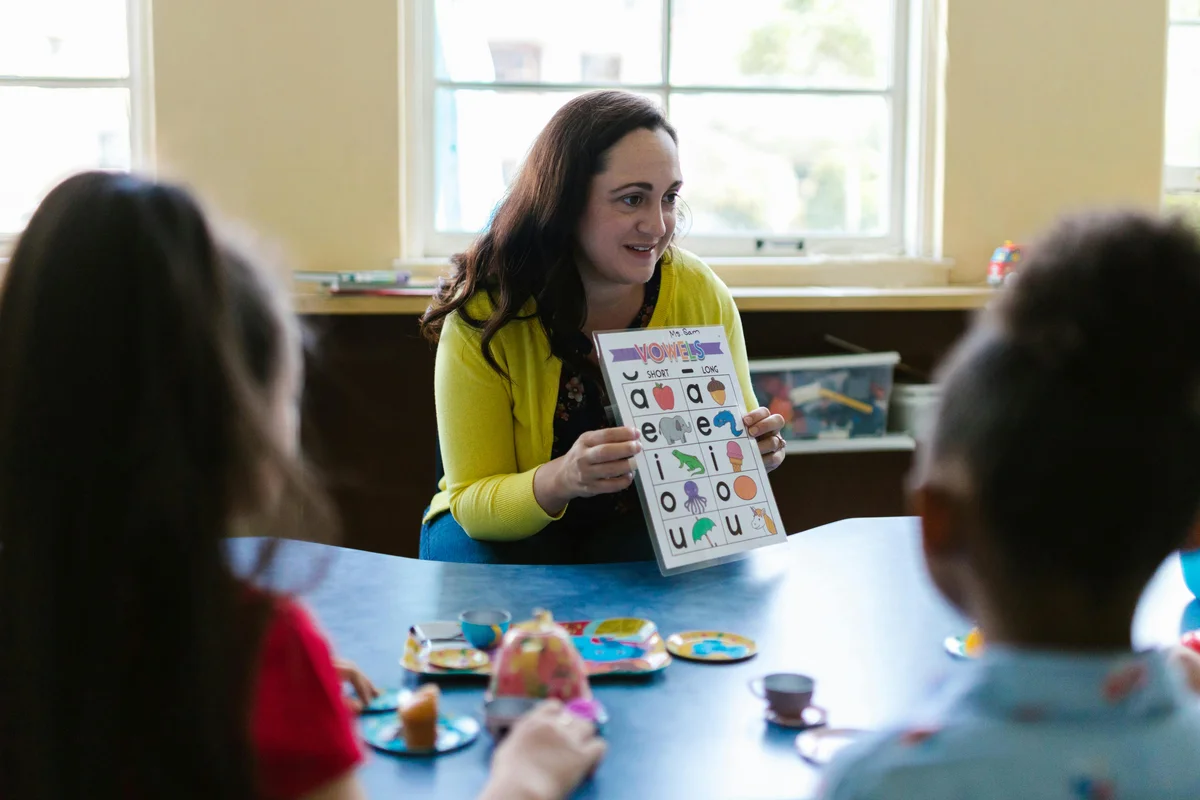
- Short vowels: a, i, o, u, e
- Remaining consonants: c, d, f, g, h, j, k, l, r, v, w, x, y, z
- Digraphs: sh, ch, th, wh
- Blends: bl, cr, st, etc.
- Long vowels: silent e, vowel teams
- Advanced patterns: r-controlled vowels, diphthongs
Daily Phonics Practice
Keep lessons short—10-15 minutes for young children. Follow this pattern:
- Review: Practice previously learned sounds (2 minutes)
- New teaching: Introduce one new sound (3 minutes)
- Practice: Read words with the new pattern (5 minutes)
- Apply: Read simple sentences or decodable books (5 minutes)
Recommended Phonics Programs
The right curriculum makes teaching much easier. See our All About Reading review and 100 Easy Lessons review for top options.
Step 3: Build Decoding Skills (Ages 5-7)
Decoding means using phonics knowledge to read unfamiliar words. This is the heart of early reading instruction.
Teaching Blending
Show your child how to blend sounds together:
- Point to each letter
- Say its sound: “mmm… aaa… ttt”
- Speed up: “maaat”
- Say the word: “mat”
Practice with word families: cat, sat, mat, rat, hat. Once children see the pattern, they decode new words faster.
Use Decodable Readers
Regular children’s books contain words kids can’t decode yet. Decodable readers use only patterns students have learned. This builds confidence and reinforces phonics skills.
Recommended decodable series:
- Bob Books
- Primary Phonics
- All About Reading readers
- Logic of English readers
Common Decoding Problems and Fixes
| Problem | Likely Cause | Solution |
|---|---|---|
| Guessing from pictures | Relying on context | Cover pictures; focus on sounds |
| Skipping words | Frustration | Use easier texts |
| Slow, choppy reading | Still learning to blend | More blending practice |
| Reversing letters | Normal until age 7 | Gentle correction, practice |
Step 4: Develop Fluency (Ages 6-8)
Fluency means reading smoothly, accurately, and with expression. Fluent readers can focus on meaning rather than decoding each word.
Strategies for Building Fluency
Repeated Reading
Have your child read the same passage 3-5 times. Each reading becomes smoother. Use a timer and celebrate improvement.
Echo Reading
You read a sentence expressively; your child echoes it back. This models fluent reading.
Partner Reading
Take turns reading sentences or paragraphs. Your fluent reading provides a model.
Audio-Assisted Reading
Let your child follow along with audiobooks while reading the text. This exposes them to fluent reading while they practice.
Step 5: Build Vocabulary and Comprehension (Ongoing)
Reading isn’t just decoding—it’s understanding. Build vocabulary and comprehension alongside phonics instruction.
Vocabulary Strategies
- Read aloud daily: Expose children to rich vocabulary above their reading level
- Discuss new words: Explain meanings in context
- Use new words: Incorporate vocabulary into conversation
- Make connections: Relate new words to known concepts
Comprehension Strategies
- Before reading: Preview the book, predict what it’s about
- During reading: Ask questions, make connections
- After reading: Retell the story, discuss favorite parts
- Visualizing: Have children picture scenes in their minds
Troubleshooting Common Problems
My Child Isn’t Making Progress
Check for phonemic awareness gaps—can they hear individual sounds in words? If not, go back to Step 1. If phonemic awareness is solid, ensure you’re teaching phonics systematically, not randomly.
My Child Hates Reading Lessons
Keep sessions short (10-15 minutes). Use games and rewards. Make sure the material isn’t too hard—frustration kills motivation. Consider whether your teaching style matches their learning style.
Should I Be Worried About Dyslexia?
Signs to watch for: persistent letter reversals past age 7, extreme difficulty blending sounds, family history of reading problems. If concerned, seek professional evaluation. Early intervention makes a huge difference.
Recommended Timeline
| Age | Focus | Expected Skills |
|---|---|---|
| 3-4 | Phonemic awareness | Rhyming, beginning sounds |
| 4-5 | Letter sounds | Know most letter sounds |
| 5-6 | Decoding CVC words | Read simple words (cat, dog) |
| 6-7 | Blends, digraphs | Read simple sentences |
| 7-8 | Long vowels, fluency | Read chapter books |
Remember: children develop at different rates. These ages are guidelines, not deadlines.
Frequently Asked Questions
What age should I start teaching reading?
Start phonemic awareness activities around age 3-4. Formal phonics instruction typically begins between ages 4-6, depending on readiness. There’s no benefit to pushing too early—wait until your child shows interest and has necessary pre-reading skills.
How long does it take to teach a child to read?
Most children learn basic reading skills within 1-2 years of systematic instruction. Some learn faster; others need more time. Consistency matters more than speed.
Do I need a curriculum?
A good curriculum ensures systematic instruction without gaps. While you can teach reading without one, curricula make the job easier. See our language arts curriculum guide for options.
What about sight words?
Some words don’t follow phonics rules and must be memorized (like “said” or “the”). Introduce these gradually alongside phonics instruction. Don’t rely on sight word memorization as your main reading method.
You Can Do This
Teaching your child to read feels daunting, but thousands of parents do it successfully every year. Follow the sequence: phonemic awareness, phonics, fluency, vocabulary, comprehension. Keep lessons short and positive. Celebrate progress.
The best gift you can give your child is literacy. With patience and consistent practice, you’ll watch them go from sounding out “cat” to devouring chapter books. That journey is worth every minute of effort.
]]>


Leave a Reply