
This post may contain affiliate links. If you purchase through these links, we may earn a small commission at no extra cost to you. We only recommend products we genuinely believe will help your homeschool.
The scientific method forms the foundation of all scientific inquiry. It’s more than memorizing steps. This process teaches children how to investigate questions step by step. They learn to evaluate evidence and draw valid conclusions. These thinking skills extend far beyond science class into every area of life.
Teaching the scientific method at home offers unique advantages. You can let children pursue questions that truly interest them. They can take time for real investigation. You can show how scientists actually work rather than following simplified textbook versions. Whether you’re using a complete science curriculum or building your own approach, this guide explains how to make scientific method lessons engaging and meaningful.
Quick Overview: The Scientific Method Steps
While presentations vary, the scientific method generally includes:
- Observation: Notice something interesting or puzzling
- Question: Ask a specific, testable question about the observation
- Research: Learn what is already known about the topic
- Hypothesis: Make an educated prediction about the answer
- Experiment: Design and conduct a test of the hypothesis
- Analysis: Examine the data collected
- Conclusion: Determine whether results support or refute the hypothesis
- Communication: Share findings with others
Understanding the Scientific Method
It Is Not Really a Recipe
Textbooks often present the scientific method as a rigid sequence of steps. However, real science rarely works this way. Scientists move back and forth between steps. They redesign experiments and revise their guesses. Sometimes they discover unexpected questions more interesting than their original ones.
So teach children that the method provides a framework for investigation, not a strict recipe. According to the National Science Teaching Association, the core principles matter more than following steps in exact order. These include careful observation, testable predictions, controlled experiments, and evidence-based conclusions.
Why It Matters Beyond Science
Scientific thinking skills transfer to countless situations:
- Evaluating claims and advertisements
- Troubleshooting problems systematically
- Making evidence-based decisions
- Recognizing bias and logical fallacies
- Understanding how we know what we know
When children learn to ask “How do we know that?” and “What evidence supports that claim?” they develop critical thinking that serves them throughout life. The U.S. Department of Education emphasizes scientific literacy as a basic skill for success in the modern world.
Teaching Each Step
Observation: The Starting Point
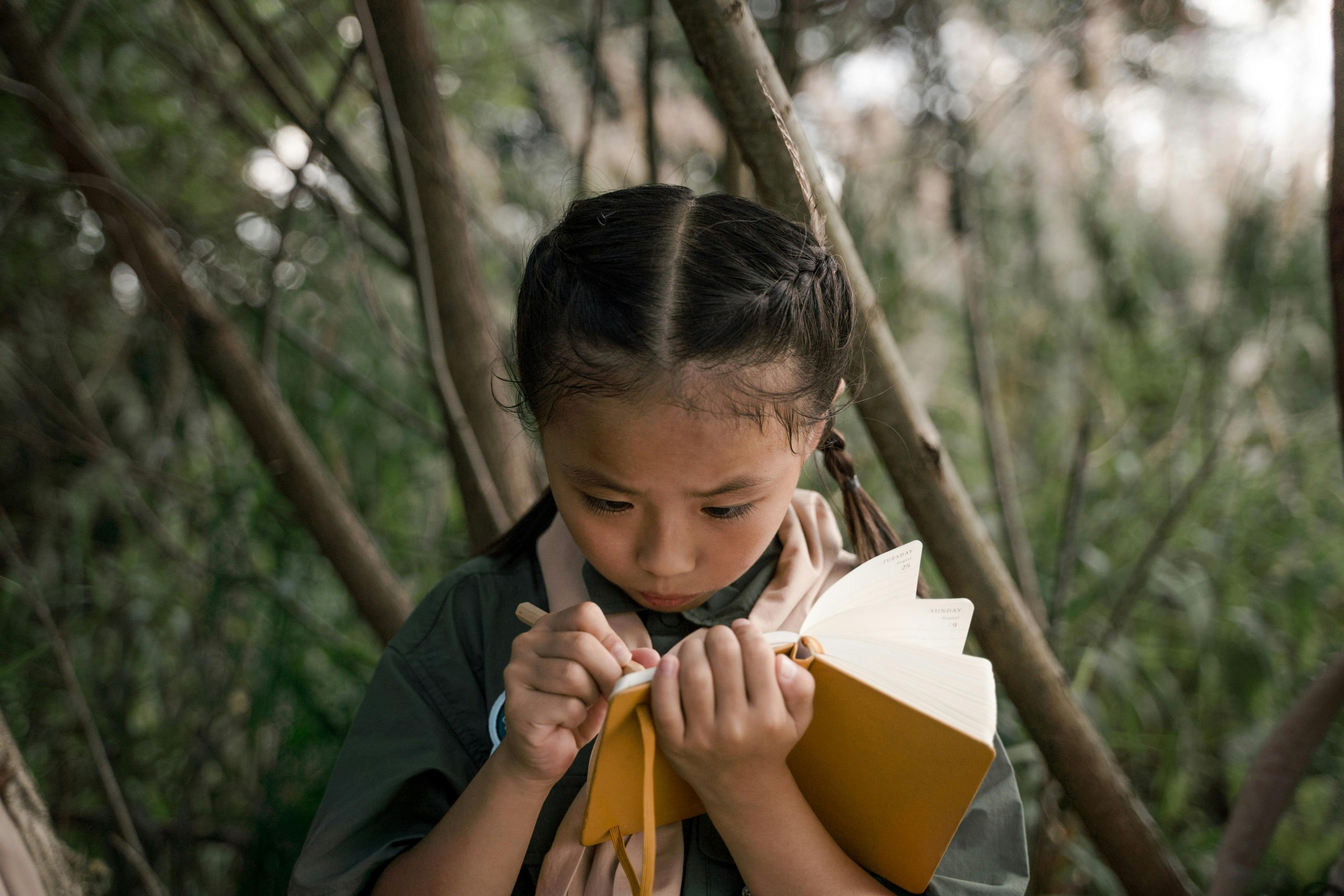
All science begins with noticing something. You can develop observation skills through various activities, and nature study provides an excellent foundation for this essential skill. Consider these approaches:
- Nature walks focused on noticing details
- Descriptive writing exercises about everyday objects
- Comparison activities (how are these similar/different?)
- Sensory observations using all five senses
- Practice describing without interpreting
Here’s a key distinction: observations describe what actually happens, while interpretations explain why. For example, “The plant is drooping” is an observation. “The plant needs water” is an interpretation. Scientists observe first, then interpret later.
Questions: Asking the Right Kind
Not all questions can be investigated scientifically. Teach children to distinguish between:
Testable questions (scientific method appropriate):
- Does fertilizer affect plant growth rate?
- Which paper towel brand absorbs the most water?
- Does temperature affect how fast sugar dissolves?
Non-testable questions (cannot investigate scientifically):
- Which flower is prettiest?
- Why are butterflies beautiful?
- Is chocolate better than vanilla?
Also, guide children to turn vague questions into testable ones. For example, “Why do plants grow?” becomes “Does the amount of light affect how tall plants grow in two weeks?”
Research: Building on Existing Knowledge
Scientists don’t start from scratch. Before experimenting, they learn what others have already discovered. So teaching research skills is essential:
- Library research on science topics
- Evaluating online sources for reliability
- Understanding that scientific knowledge builds over time
- Recognizing how new findings fit with established understanding
For children’s experiments, research might mean reading about the topic in science books, checking previous experiments online, or asking knowledgeable adults.
Hypothesis: Making Educated Predictions
A hypothesis isn’t just a guess. It’s a prediction based on what we already know. Teach the “If…then…because…” format:
- If I increase the amount of fertilizer,
- Then plants will grow taller,
- Because fertilizer provides nutrients plants need for growth.
The “because” portion connects the prediction to prior knowledge or reasoning. This distinguishes hypotheses from random guesses.
Also, stress that hypotheses can be wrong. Finding out a hypothesis is wrong is valuable learning, not failure. Many important discoveries came from wrong guesses. This mindset helps when working with hands-on science curriculum that encourages experimentation.
Experiment: Testing Fairly
Understanding variables is crucial for experimental design:
- Independent variable: What you deliberately change
- Dependent variable: What you measure (the outcome)
- Controlled variables: What you keep the same
A fair test changes only one variable at a time. For example, if you change both the fertilizer amount AND the water amount, you can’t tell which one caused any difference in plant growth.
Teach experimental design by:
- Identifying variables in published experiments
- Finding flaws in poorly designed experiments
- Planning simple experiments with clear variable control
- Discussing why controls matter
Data Collection and Analysis
Data must be recorded systematically. Teach children to:
- Design data tables before starting experiments
- Record measurements precisely and consistently
- Include units with all measurements
- Note unexpected observations
- Create graphs to visualize relationships
Analysis involves looking for patterns, finding averages, and checking whether results are steady. Students should ask: Did all trials show similar results, or were there outliers? Do the data support the hypothesis?
Drawing Conclusions
Conclusions must connect directly to the data collected. Teach children to:
- State whether the hypothesis was supported or not
- Cite specific evidence from the experiment
- Acknowledge limitations and potential errors
- Suggest improvements for future experiments
- Propose new questions raised by the results
Conclusions should be modest. A single experiment rarely proves anything for certain. Scientists say results “support” or “fail to support” hypotheses rather than “prove” them.
Communication: Sharing Findings
Science requires sharing results so others can evaluate and build on findings. So communication skills are essential. Practice these skills through:
- Oral presentations of experiment results
- Written lab reports following standard format
- Science fair displays
- Explaining experiments to family members
- Creating videos or demonstrations
Age-Appropriate Approaches
The way you teach scientific method should match your child’s developmental stage. The best science curriculum by grade level takes these differences into account.
Early Elementary (K-2)
At this stage, focus on observation and simple predictions:
- Wonder walks: “I notice… I wonder…”
- Simple predictions: “What do you think will happen?”
- Observation journals with drawings
- Sorting and classifying activities
- Simple fair tests (which rolls farther: big ball or small ball?)
Upper Elementary (3-5)
During these years, introduce formal steps and variable control:
- Guided experiments with explicit discussion of variables
- Simple data tables and graphs
- Written predictions with reasons
- Basic lab report format
- Identifying flaws in simple experimental designs
Middle School (6-8)
At the middle school level, develop independence and rigor:
- Student-designed experiments
- Multiple trials and averaging
- Formal lab reports with all sections
- Error analysis and sources of uncertainty
- Evaluating claims in media using scientific thinking
High School (9-12)
For high schoolers, emphasize college-preparatory scientific methodology:
- Original research questions and designs
- Statistical analysis of results
- Professional lab report format
- Peer review of experimental designs
- Understanding how published science works
Sample Experiments by Skill Level
Beginner: Ice Cube Melting Race
Question: Does wrapping material affect how fast ice melts?
Variables:
- Independent: Type of wrapping (paper towel, foil, plastic wrap, nothing)
- Dependent: Time until completely melted
- Controlled: Ice cube size, starting temperature, room conditions
This experiment uses household materials, completes quickly, and has clear results. Perfect for introducing variable control concepts.
Intermediate: Plant Growth Investigation
Question: How does the amount of light affect plant growth?
Variables:
- Independent: Amount of daily light exposure
- Dependent: Plant height, number of leaves, overall health
- Controlled: Water amount, soil type, temperature, pot size
Extended observation time teaches patience. Multiple measurements allow graphing and analysis practice.
Advanced: Enzyme Activity Study
Question: How does temperature affect enzyme activity?
Variables:
- Independent: Temperature of reaction
- Dependent: Rate of oxygen production (bubble count)
- Controlled: Enzyme concentration, substrate concentration, timing
Requires precise measurement and multiple trials. Results can be analyzed mathematically and compared to known enzyme behavior.
Common Mistakes to Avoid
Changing Multiple Variables
Children often want to test several things at once. Patiently explain why this prevents knowing what caused any observed effect. Design experiments that isolate single variables.
Confirmation Bias
We all tend to notice evidence supporting what we already believe. Therefore, teach children to look specifically for evidence that might disprove their hypothesis. Good scientists try to prove themselves wrong.
Drawing Conclusions Beyond the Data
One experiment on one day proves very little. Conclusions should be appropriately modest and limited to what the data actually show.
Skipping the “Why It Matters” Discussion
Connect scientific method skills to real-life applications. How might this skill help you make decisions? Evaluate advertisements? Solve problems? Making connections builds lasting understanding.
Frequently Asked Questions
At what age should children learn the scientific method?
Children naturally investigate from toddlerhood. Formal scientific method teaching typically begins around third grade. However, younger children benefit from observation and prediction activities. Match lessons to your child’s readiness rather than rigid age guidelines. Even kindergarteners can learn simple predictions and fair testing concepts.
How do I teach the scientific method without a science background?
The scientific method is a thinking process, not content knowledge. You can guide children through steps without knowing the science they study. Learn alongside them, model curiosity, and focus on the process rather than having all the answers. Many resources explain concepts in ways adults can easily grasp.
What if experiments do not work as expected?
Unexpected results provide the best learning chances. Ask: Why might this have happened? What could we do differently? Was there a problem with our steps? Real scientists deal with failed experiments all the time. Learning to fix problems is key scientific training.
How often should we practice scientific method skills?
Formal experiments might happen weekly or monthly. But scientific thinking can be practiced daily. Ask “What do you think will happen?” before everyday activities. Wonder aloud about things you notice. Discuss evidence for claims you come across. Frequent informal practice builds good thinking habits.
Do all science activities need to follow the scientific method?
No. Demos, observations, nature study, and free exploration all have educational value without formal steps. However, students should regularly experience full investigations. This helps them understand how scientific knowledge develops. Balance structured method practice with open exploration.
Making It Stick
Scientific method understanding deepens through repeated practice with varied content. Apply the framework to:
- Questions that arise naturally in daily life
- Problems in other subject areas
- Evaluating claims in news and advertising
- Personal decisions requiring evidence gathering
- Understanding how scientists make discoveries
Over time, step-by-step investigation becomes second nature. Children learn to ask better questions, design fair tests, evaluate evidence, and draw sound conclusions. These skills serve them far beyond science class. They’ll be ready to navigate a world full of competing claims and complex problems.
The scientific method isn’t just for scientists. It’s a powerful thinking tool that belongs in every educated person’s toolkit. By teaching it well at home, you give your children ways to understand their world. You help them solve problems they haven’t yet imagined.
Start with simple investigations, build complexity gradually, and always emphasize the why behind each step. If you’re looking for structured support, explore our guide on how to teach science at home for more detailed curriculum recommendations. Your children will develop scientific thinking habits that benefit them throughout their lives.
Leave a Reply