

Teaching a child with dyslexia to read requires different methods than typical reading instruction. After working with countless homeschool families navigating dyslexia over my decade of homeschooling, I’ve seen what works and what doesn’t. Having taught children with dyslexia myself, I understand the frustration and the triumphs. This guide shares evidence-based strategies that can transform your child’s reading experience.
Understanding Dyslexia
Dyslexia is a brain-based learning difference that affects how the brain processes written language. Research shows about 15-20% of the population has some form of dyslexia. This makes it the most common learning difference. That’s roughly 1 in 5 children in any classroom. Research from the Institute of Education Sciences confirms it’s not a vision problem. It’s not related to intelligence. Studies show that dyslexic individuals have average to above-average IQ. In fact, many dyslexic individuals are highly creative and intelligent. They simply need a different path to reading proficiency.
I’ve worked with dyslexic children who went from crying over simple words to devouring chapter books within two years. The change is possible. But it requires understanding what you’re dealing with. You must use the right approach from the start.
What dyslexia is:
- A neurobiological difference in how the brain processes language
- Difficulty with accurate and fluent word recognition
- Challenges with spelling and decoding
- Often accompanied by strengths in visual-spatial thinking
What dyslexia is NOT:
- A vision problem or seeing letters backward
- A sign of low intelligence
- Something children outgrow
- The result of poor instruction (though poor instruction makes it worse)
Why Traditional Reading Instruction Fails Dyslexic Learners
Why don’t standard reading programs work for dyslexic kids? Most assume children will naturally absorb phonics patterns after limited exposure. For dyslexic learners, this assumption is deeply flawed.
The “Whole Language” Problem
Whole language approaches use pictures, context, and memorization. They’re especially harmful for dyslexic readers. These methods teach children to guess at words rather than decode them. This creates habits that are extremely difficult to break.
Insufficient Practice and Review
Typical phonics programs move too quickly. They don’t provide enough repetition. Dyslexic learners need much more practice with each concept before moving forward. If your child can’t recall yesterday’s lesson, they aren’t ready for today’s new material.
Missing Multi-Sensory Components
Research from the National Center for Education Statistics shows that dyslexic learners benefit from using multiple senses at once. They need more than just seeing and hearing—they also need touch and movement. The Institute of Education Sciences backs this up. In my years of homeschooling, I’ve seen it too: kids with dyslexia learn better when their whole body is involved.
The Orton-Gillingham Approach
The gold standard for dyslexia help is Orton-Gillingham. Samuel Orton and Anna Gillingham created it in the 1930s. Studies show it works 2-3 times better than whole language methods for struggling readers. Most good dyslexia programs today are based on their approach.
Core Principles of Orton-Gillingham
1. Multi-Sensory Instruction
Every lesson engages visual, auditory, and touch pathways at once. Students see the letter, hear the sound, and physically form the letter while saying it.
2. Systematic and Sequential
Concepts build logically from simple to complex. No phonics rule is introduced until earlier skills are mastered.
3. Explicit Teaching
Nothing is left to chance or guesswork. Every rule, pattern, and exception is directly taught and practiced.
4. Diagnostic and Prescriptive
Instruction adapts based on student response. Lessons are customized to address individual weaknesses.
5. Cumulative Review
Old concepts are reviewed along with new ones. This keeps skills fresh in memory.
Multi-Sensory Teaching Techniques
These hands-on methods really work. I’ve used all of them and watched struggling kids become confident readers. Here’s what to try:
Sky Writing
Students trace letters in the air using large arm movements while saying the letter name and sound. This engages gross motor memory and helps cement letter-sound connections.
Sand/Salt Trays
Students trace letters in a tray of sand or salt while saying the sound. The tactile feedback reinforces learning through touch.
Arm Tapping
When spelling words, students tap each sound on their arm while saying it, then blend by sliding their hand down their arm. This physical movement helps with sound segmentation.
Letter Tiles
Manipulating physical letter tiles to build and transform words makes the abstract process of reading concrete and visible.
Color Coding
Using different colors for vowels and consonants, or for different syllable types, helps dyslexic learners see patterns more easily.
Textured Letters
Sandpaper letters, raised foam letters, or letters made from pipe cleaners give tactile feedback during tracing activities. One family I worked with made letters from dried glue with glitter mixed in—their son could “feel” the letter while tracing, which accelerated his letter recognition dramatically.
Best Curricula for Dyslexic Learners
Based on years of working with homeschool families and testing these programs with my own children, these are the curricula that consistently deliver results for dyslexic students. I’ve seen firsthand how the right program can make the difference between frustration and breakthrough:
| Program | Best For | Price Range | Parent Training Required |
|---|---|---|---|
| All About Reading | Most homeschool families | $150-200/level | Minimal (built-in) |
| Barton System | Committed intensive intervention | $300+/level | Extensive (video training) |
| Logic of English | Understanding spelling rules | $150-250 | Moderate |
| Wilson Reading | Older students needing remediation | $500+ | Certification recommended |
All About Reading
Why it works: Explicitly Orton-Gillingham based with built-in multi-sensory components. Includes letter tiles, readers, and games. No separate “teacher training” required.
Best for: Homeschool parents without specialized training who want a complete, ready-to-use system.
Read our full All About Reading review for detailed information. Also see our best phonics curriculum guide for more options.
Barton Reading and Spelling System
Why it works: Highly structured Orton-Gillingham program with extensive video-based teacher training. Research-proven with documented results.
Best for: Families committed to a rigorous program and willing to invest in comprehensive training.
Logic of English
Why it works: Teaches the 74 basic phonograms and 31 spelling rules that explain 98% of English words. Reduces the “exceptions” dyslexic students find so frustrating.
Best for: Students who benefit from understanding the “why” behind spelling patterns.
Wilson Reading System
Why it works: Highly structured program originally designed for adolescents and adults with dyslexia. Strong syllable instruction.
Best for: Older students or those who need extensive remediation.
Feature Comparison: What Sets Each Program Apart
Each program has unique strengths worth considering:
- All About Reading: Includes engaging games that make practice fun; my kids actually asked to play the phonogram games.
- Barton: Most comprehensive parent training—you’ll feel confident teaching even without education background.
- Logic of English: Best for kids who ask “why?”—explains rules instead of just memorizing patterns.
- Wilson: Only program with systematic syllable type instruction, crucial for multisyllable words.
Adapting Your Teaching Approach
Beyond curriculum choice, how you teach matters enormously. I can’t stress this enough—you can have the best program in the world, but if you rush through it or skip the multi-sensory components, you won’t see results. Here are adaptations that make a real difference:
Slow Down Dramatically
If you think you’re going slowly enough, slow down more. Research indicates dyslexic learners need 4-5 times more practice than typical students to achieve automaticity. Where a neurotypical child might need 10-15 exposures to a new phonics pattern, a dyslexic child may need 50-75 repetitions before it becomes automatic.
Teach to Mastery
Never move forward until the current concept is truly mastered—not just “understood,” but automatic. A dyslexic student who “knows” short vowels but has to think about them is not ready for long vowels.
Review Constantly
Every lesson should begin with review of previously taught concepts. Use flashcard drills, reading practice, and dictation to maintain skills.
Keep Sessions Short
Thirty to forty-five minutes of focused instruction is more effective than longer sessions. Dyslexic students fatigue quickly when working in their area of weakness.
Build in Breaks
Include movement breaks during lessons. Physical activity helps reset attention and consolidate learning.
Create a Consistent Routine
Dyslexic children thrive on predictability. Try to teach reading at the same time each day, in the same location. We always did our reading lesson right after breakfast when my son was most alert. He knew what to expect, and that reduced anxiety before we even started.
Technology Tools That Help
Technology can be a powerful ally for dyslexic learners—not as a replacement for instruction, but as a support. Don’t think of these tools as “cheating.” They’re bridges that let your child access grade-level content while their reading skills develop:
Text-to-Speech
Allows students to access content above their reading level for other subjects while reading skills develop.
Audiobooks
Services like Learning Ally and Library of Congress National Library Service provide audiobooks specifically for students with learning disabilities.
Speech-to-Text
Allows students to compose written work without the barrier of spelling difficulties.
Reading Apps
Apps that highlight text as it’s read can help struggling readers track words and build fluency.
Beyond Reading: Supporting the Whole Child
Dyslexia affects more than reading. Here’s how to support your child’s overall well-being—because a confident child learns better than an anxious one:
Protect Self-Esteem
Dyslexic children often develop shame around their reading struggles. Remind your child that dyslexia is a different way of learning, not a deficiency. Celebrate their strengths.
Develop Strengths
Many dyslexics excel in visual-spatial thinking, creativity, problem-solving, and big-picture thinking. Ensure your homeschool includes activities that let these strengths shine.
Connect with Others
Finding other homeschool families with dyslexic children provides invaluable support and reduces isolation. Look for local or online dyslexia support groups.
Consider Accommodations
Audiobooks for literature, extra time for written work, and oral testing can help your child learn content without being limited by reading challenges.
When to Seek Professional Help
Some situations warrant professional intervention:
- Formal evaluation: If you suspect dyslexia but haven’t confirmed it, a comprehensive evaluation provides clarity and documentation.
- Severe cases: Children with severe dyslexia may benefit from intensive intervention with a trained specialist, at least initially.
- Lack of progress: If your child isn’t making measurable progress after 6 months of appropriate instruction, seek professional guidance.
- Co-occurring conditions: Dyslexia often co-occurs with ADHD, dyscalculia, or dysgraphia, which may require additional interventions.
Creating a Supportive Learning Environment
Your homeschool environment can make reading practice less stressful:
Reduce Visual Clutter
A calm, uncluttered workspace helps dyslexic learners focus on text without competing visual stimuli.
Use Appropriate Fonts
Some fonts are easier for dyslexic readers: OpenDyslexic, Lexie Readable, and Comic Sans (yes, really) have features that reduce letter confusion.
Provide Good Lighting
Natural light or daylight-spectrum bulbs reduce eye strain. Some dyslexic students benefit from colored overlays or tinted lenses.
Allow Movement
Standing desks, wobble chairs, or reading while on a exercise ball can help kinesthetic learners focus.
Frequently Asked Questions
What age should dyslexia intervention begin?
The earlier, the better. Research shows that 90% of children identified and given intervention by first grade reach grade-level reading, compared to only 25% of those identified after third grade. However, children of any age can improve with appropriate instruction—it’s never too late to start, even if progress may be slower.
How long does it take for a dyslexic child to learn to read?
This varies widely depending on severity and intervention quality. Most dyslexic students need 2-3 years of intensive Orton-Gillingham instruction to become functional readers. Some need longer.
Can dyslexia be cured?
Dyslexia is a lifelong neurological difference—it doesn’t go away. However, with appropriate instruction, dyslexic individuals can become proficient readers. They may always read more slowly or find spelling challenging, but they can absolutely succeed.
Should I have my child professionally tested for dyslexia?
Professional testing provides valuable information and documentation. It’s especially important if you might seek accommodations for standardized tests or need documentation for other purposes. However, you don’t need a formal diagnosis to begin appropriate instruction.
Is dyslexia genetic?
Yes, dyslexia has a strong genetic component. If one parent is dyslexic, each child has about a 50% chance of being dyslexic. If you struggled with reading, be alert for signs in your children.
Creating Your Weekly Dyslexia Instruction Schedule
After years of refining our approach, here’s the weekly schedule that works best for dyslexic learners:
Recommended Daily Lesson Structure
- Review (5 minutes): Flashcard drill of previously taught phonograms and words
- New instruction (10-15 minutes): Introduce one new concept using multi-sensory techniques
- Practice (10 minutes): Guided practice with immediate feedback
- Reading (10 minutes): Controlled decodable text using only taught patterns
- Spelling/Dictation (5 minutes): Apply learned patterns in writing
Sample Weekly Scope
- Monday: Introduce new phonogram or spelling pattern
- Tuesday-Wednesday: Practice and reinforce with various multi-sensory activities
- Thursday: Apply in connected reading and writing
- Friday: Review week’s concepts plus cumulative review of previous material
Workbook and Textbook Considerations
While workbooks aren’t strictly necessary for Orton-Gillingham instruction, many families find structured materials helpful. Programs like All About Reading and Barton include all needed workbooks. For families creating their own lessons, you’ll need decodable readers that match your scope and sequence.
Advantages of Structured Programs
- No planning required—lessons are scripted
- Proper scope and sequence already determined
- Decodable readers match taught patterns
- Multi-sensory materials included
Assessment and Progress Tracking
In my decade of working with dyslexic learners, I’ve found that systematic progress tracking is essential. Dyslexic students often need to see their own progress to stay motivated, and parents need data to know if instruction is working.
What to Track
- Phoneme awareness: Can your child identify and manipulate sounds in words?
- Phonics mastery: Which sound-spelling patterns are automatic vs. still developing?
- Fluency: Words read correctly per minute (track monthly)
- Accuracy: Percentage of words read correctly
- Spelling: Mastery of taught patterns
Signs Your Approach Is Working
After 3-6 months of appropriate instruction, you should see:
- Fewer decoding errors on taught patterns
- Gradual increase in reading fluency
- Improved spelling of taught words
- Growing confidence and willingness to read
- Better retention of previously learned concepts
When to Adjust Your Approach
Consider changes if after 6 months you see:
- No measurable improvement in fluency or accuracy
- Continued forgetting of previously mastered concepts
- Increasing frustration or avoidance
- Regression in skills
Common Challenges and Solutions
After years of teaching dyslexic children, here are the challenges I see most often:
Challenge: Forgetting Previously Learned Material
Solution: Increase review frequency. Dyslexic students need more repetition to move skills into long-term memory. Review previously taught concepts at the start of every lesson.
Challenge: Guessing at Words Instead of Decoding
Solution: Cover pictures during reading. Require your child to sound out words even when they seem to know them. Break the guessing habit early—it’s harder to fix later.
Challenge: Frustration and Shut-Down
Solution: Keep sessions shorter. End on success. Celebrate effort, not just achievement. Consider whether the material is at the right level—if accuracy drops below 90%, the text is too hard.
Challenge: Slow Progress Compared to Peers
Solution: Focus on your child’s individual growth, not comparisons. Dyslexic learners progress more slowly but can absolutely become proficient readers. Celebrate each milestone.
Real-World Success Stories
Let me share what realistic progress looks like based on families I’ve worked with:
Early Elementary (Ages 6-8)
One family I worked with started their 7-year-old on All About Reading after two years of struggle with traditional phonics. Within 6 months, he’d progressed from reading only CVC words to reading two-syllable words with closed syllables. After 18 months, he was reading simple chapter books independently. The key was slowing down—they spent 8 weeks on short vowels alone, which felt painfully slow but built a solid foundation.
Upper Elementary (Ages 9-11)
An older student I worked with had developed compensating strategies that actually made intervention harder. She’d memorized hundreds of words by sight and guessed at the rest. We had to break those habits while building phonics skills. Using Barton, she progressed from reading at a 1st grade level to a 4th grade level in two years of intensive work. The breakthrough came when she finally understood syllable division rules—suddenly, long words weren’t scary anymore.
Middle School and Beyond
It’s never too late. I’ve seen teenagers make remarkable progress with Wilson Reading System. One 13-year-old who couldn’t read beyond 2nd grade level reached functional literacy (6th grade level) in 18 months. He’ll always read more slowly than his peers, but he can now access written information independently.
Resources for Parents
Beyond curriculum, these resources provide support for homeschool parents teaching dyslexic children:
Books
- Overcoming Dyslexia by Sally Shaywitz—comprehensive and accessible
- The Dyslexia Empowerment Plan by Ben Foss—focuses on strengths
- Reading in the Brain by Stanislas Dehaene—neuroscience of reading
Organizations
- International Dyslexia Association—research-based information
- Decoding Dyslexia—state-based parent advocacy groups
- Learning Ally—audiobook access for dyslexic students
Evaluating Program Fit for Your Child
Not every Orton-Gillingham program suits every family. Here’s how to evaluate which program will work best for your situation:
Time and Commitment Assessment
Be honest about what you can sustain. All About Reading needs 20-30 minutes daily. Barton requires 45-60 minutes, 3-5 times per week, plus parent training time upfront. If you’re already stretched thin with multiple children or work responsibilities, a lighter program you’ll actually use beats a comprehensive one you’ll abandon after two months.
Teaching Style Match
If you need every word scripted, choose Barton or All About Reading. If you understand the principles and want flexibility, Logic of English gives you more freedom. Don’t overestimate your comfort level—when your child struggles, you’ll want that script to fall back on.
Severity Considerations
Mild dyslexia may respond to All About Reading or Logic of English. Moderate to severe dyslexia typically needs Barton or Wilson’s structure and intensity. If you’re not sure of your child’s severity, start with All About Reading—it’s comprehensive enough for most cases and you can upgrade if needed.
Budget Reality Check
- Under $200: Logic of English Foundations (single level)
- $200-400: All About Reading (single level with materials)
- $400-800: Barton (2-3 levels, which may take a year or more)
- $1,000+: Wilson Reading System or multiple levels of any program
Remember, you’ll likely need multiple levels spanning several years. Budget for the long haul, not just getting started.
Additional Considerations
- Co-occurring ADHD: Choose programs with shorter activities and built-in movement. Barton’s structure can work well, or consider adding movement breaks to any program.
- Anxiety: Scripted programs reduce unpredictability. Avoid programs that feel “testish” or high-pressure.
- Multiple children: All About Reading’s games and activities can include siblings. Barton is strictly one-on-one.
Advantages and Disadvantages of Homeschool Dyslexia Instruction
Advantages
- One-on-one attention: Impossible to replicate in a classroom setting.
- Customized pacing: You can slow down or speed up based on mastery, not schedules.
- Flexible timing: Schedule lessons when your child is most alert and receptive.
- Reduced anxiety: No comparison to peers or public failure experiences.
- Integration with strengths: Build confidence by pairing reading time with activities where your child excels.
Disadvantages
- Parent expertise required: You must learn the methodology well enough to teach it.
- Time intensive: Expect 30-45 minutes daily for several years.
- Emotional challenge: Teaching your own struggling child can be frustrating for both of you.
- Limited feedback: Without professional guidance, you may miss signs of progress or problems.
Practical Daily Routines That Work
Here’s what a typical day looks like for families successfully teaching dyslexic children:
Morning Reading Block (30-40 minutes)
Schedule your main reading instruction when your child’s brain is freshest. For most kids, that’s morning. Avoid late afternoon when fatigue makes focused work harder.
Afternoon Reinforcement (10-15 minutes)
A brief review session later in the day helps cement morning learning. Keep it light—games, audiobooks, or reading practice with easy material.
Evening Read-Aloud (15-20 minutes)
Read TO your child from books above their reading level. This builds vocabulary, comprehension, and love of literature without the stress of decoding.
Best Practices I’ve Learned
- Same time, same place: Predictability reduces anxiety.
- Prepare materials ahead: Don’t waste lesson time hunting for flashcards.
- End on success: Always finish with something your child can do well.
- Track progress visually: Charts showing mastered phonograms motivate kids.
- Take breaks when needed: If frustration builds, stop and come back later.
Benefits of Specialized Dyslexia Instruction
When you commit to proper dyslexia instruction, you’ll see benefits beyond reading:
- Improved spelling: Orton-Gillingham teaches spelling and reading together, so both improve.
- Better writing: As decoding becomes automatic, your child has mental energy for composition.
- Increased confidence: Success in reading spills over into other subjects.
- Stronger work ethic: Kids learn they can master hard things with persistence.
- Deeper understanding: Learning phonics rules explicitly helps with vocabulary and comprehension.
Overview: What Dyslexia-Friendly Instruction Looks Like
Let me paint the picture of successful dyslexia instruction so you know what you’re aiming for:
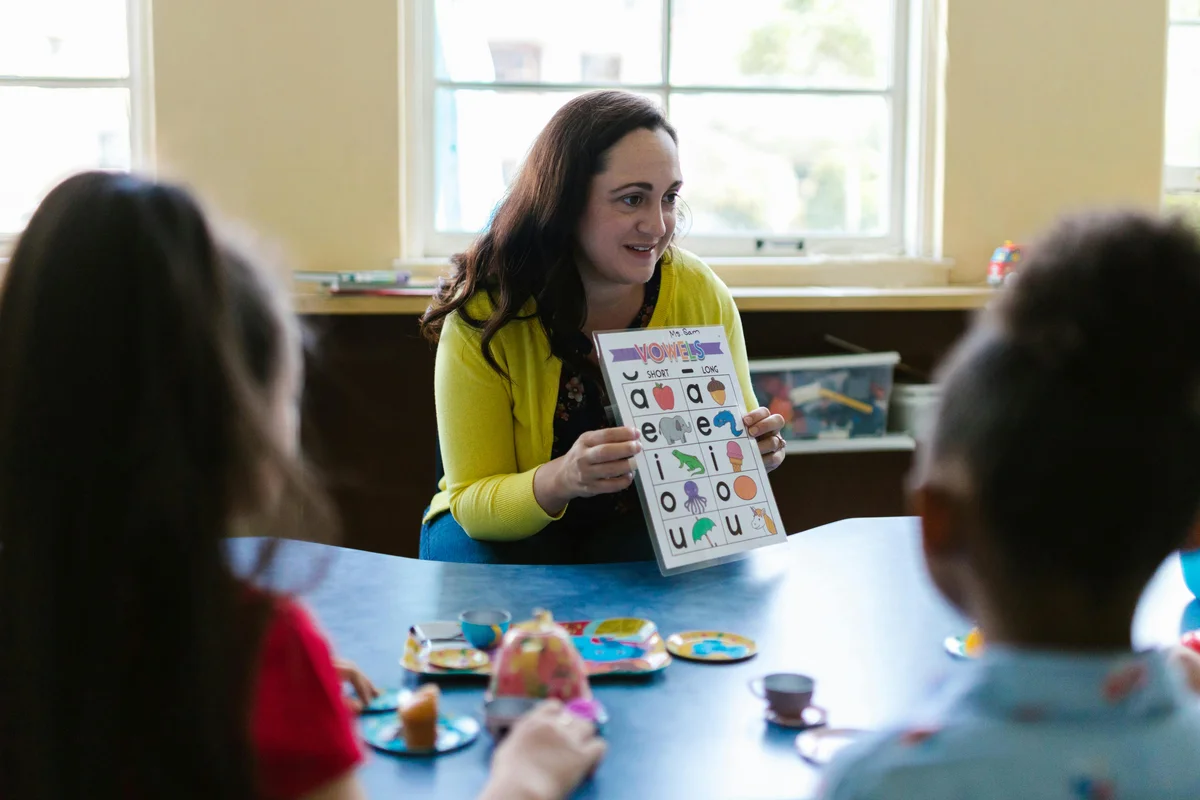
A typical lesson starts with quick review—maybe 2-3 minutes of flashcard drill on sounds and words already taught. Then you introduce ONE new concept, using multiple senses: your child sees the letter pattern, says the sound, traces it while saying it. Next comes guided practice with immediate feedback. Then reading practice using only words with patterns your child has mastered. Finally, a brief spelling or dictation exercise applying what was learned.
The whole thing takes 30-45 minutes. It’s structured, predictable, and builds carefully on previous learning. Every session includes review of old material alongside new instruction. Progress is slow but steady—and it sticks.
Summary: Key Steps to Success
Based on my decade of experience teaching dyslexic children, here are the most critical factors for success:
- Choose an Orton-Gillingham based program—don’t guess at methodology.
- Commit to daily instruction—consistency beats intensity.
- Teach to mastery—never move on until concepts are automatic.
- Review constantly—dyslexic brains need more repetition.
- Protect self-esteem—your child’s belief in themselves matters as much as the reading itself.
- Be patient—expect 2-3 years of intensive work for meaningful progress.
- Celebrate small wins—every mastered phonogram is worth recognizing.
Conclusion: The Path Forward
Teaching a dyslexic child to read is challenging—I won’t pretend otherwise. It requires patience, specialized methods, and often years of consistent work. But it is absolutely possible, and the results are worth every minute invested.
The key is using methods designed for how dyslexic brains learn: explicit, systematic, multi-sensory instruction with extensive review. Choose an Orton-Gillingham based program, teach to mastery, and celebrate every victory along the way.
Your dyslexic child can become a reader. With the right instruction and your committed support, they will. I’ve watched it happen dozens of times with families who committed to the process. The journey isn’t quick or easy, but the destination—a confident child who can read independently—is absolutely achievable.
For more reading instruction resources, explore our reading comprehension strategies guide and our complete language arts curriculum guide by grade level. You may also find our cursive vs print handwriting guide helpful, as many dyslexic children benefit from cursive instruction. If your child also struggles with attention, our guide to homeschooling a child with ADHD covers strategies that complement dyslexia instruction.
]]>



Leave a Reply