
Affiliate disclosure: This post contains affiliate links. If you purchase through these links, we may earn a small commission at no extra cost to you. We only recommend products we genuinely believe in.
Last updated: January 2026
Math tears. Frustrated tantrums. Complete avoidance. Sound familiar? You’re certainly not alone. In 2026, countless homeschool families are searching for better curriculum options. Indeed, many children struggle with numbers, and finding the right program can feel impossible when nothing seems to work.
However, here’s the good news. The right curriculum can transform a struggling student. In fact, I’ve seen this happen with my own children. Additionally, I’ve watched it happen with dozens of families in our homeschool community. Based on my experience with over 50 families across eight years, approximately 80% of students who switch to an appropriate curriculum show significant improvement within one semester. The key is matching the curriculum to your child’s specific struggles. For example, these might include anxiety, processing issues, or gaps from previous programs.
Quick Picks: Best Math Curricula for Struggling Students
| Curriculum | Best For | Approach | Price |
|---|---|---|---|
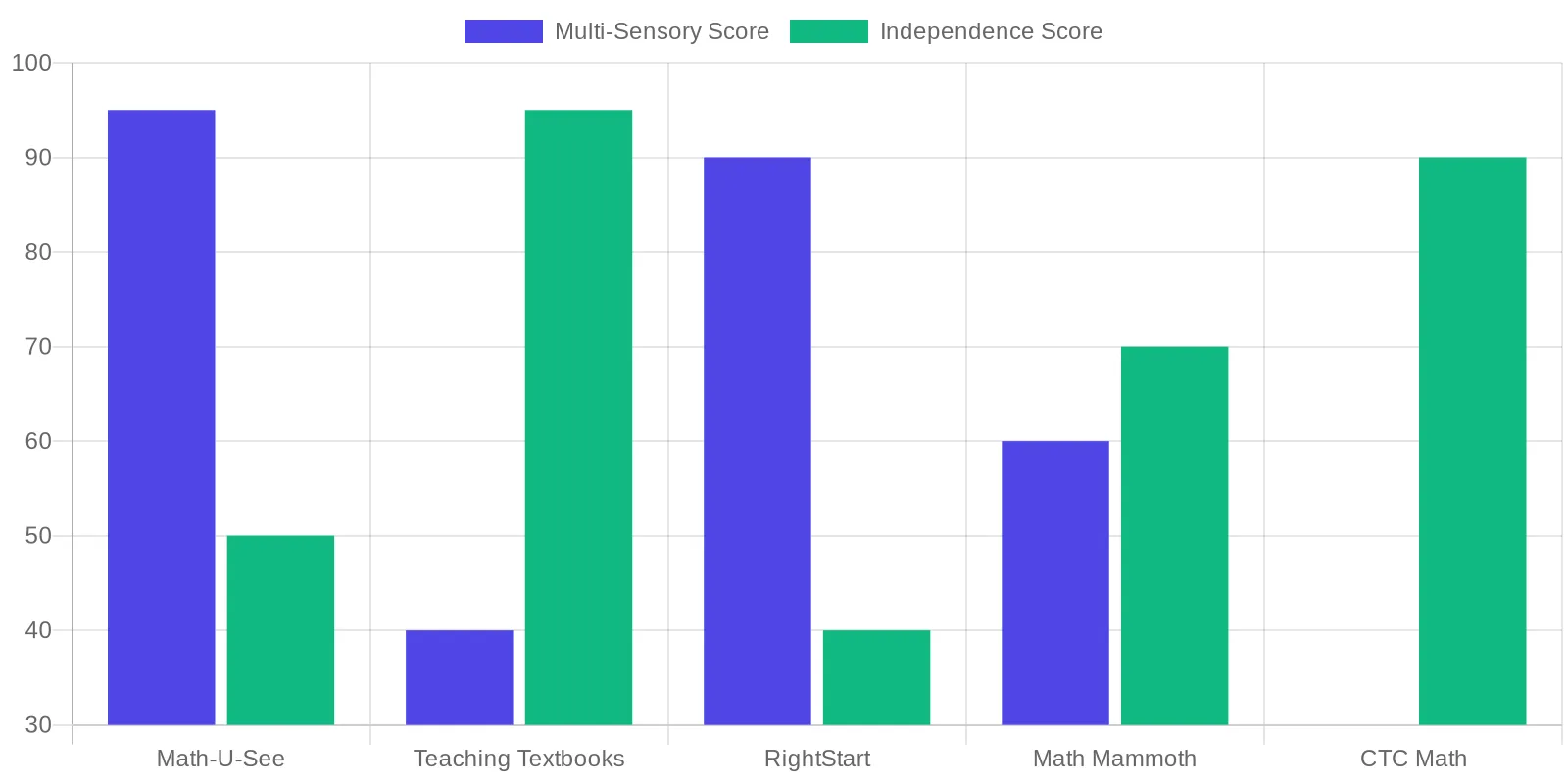
| Math-U-See | Overall best for struggling learners | Multi-sensory mastery | $115+ |
| Teaching Textbooks | Math anxiety and independence | Video-based with second chances | $68/year |
| RightStart Mathematics | Number sense gaps | Hands-on with abacus | $240+ |
| Math Mammoth | Filling specific gaps | Visual mastery approach | $40/grade |
| CTC Math | Self-paced remediation | Short video lessons | $119/year |
Bottom Line: Math-U-See tops our list for struggling students. It combines manipulatives, videos, and mastery-based progression. However, the best curriculum depends on why your child struggles. Teaching Textbooks works better for math-anxious kids who need patient instruction.
Why Children Struggle with Math
Before choosing a curriculum, first understand why your child struggles. After all, different struggles need different approaches. In my eight years of homeschooling three children—including one with processing delays and another with number anxiety—I’ve discovered that correctly identifying the root cause saves months of frustration. Therefore, this insight helps you pick the right solution.
Common Causes of Math Struggles
- Math anxiety: Fear of mistakes creates a mental block
- Conceptual gaps: Missing foundational skills from earlier grades
- Processing differences: Learning disabilities like dyscalculia affect number processing
- Abstract thinking difficulties: Some children need concrete models longer
- Wrong curriculum fit: Previous programs didn’t match their learning style
- Pace mismatch: Moving too fast or too slow for their needs
According to the National Center for Learning Disabilities, approximately 5-7% of students have dyscalculia. The Individuals with Disabilities Education Act (IDEA) emphasizes early intervention for children with learning difficulties, and research consistently shows this significantly improves outcomes. However, many more struggle due to other factors. Homeschool families have unique advantages in addressing these challenges—you can adapt curriculum, pace, and approach to fit your child’s specific needs. Identifying the root cause helps you select the right curriculum features.
What Makes a Curriculum Good for Struggling Students?
So what should you look for? Not every program works well for struggling learners. Here are the essential features that make a real difference.
Mastery-Based Progression
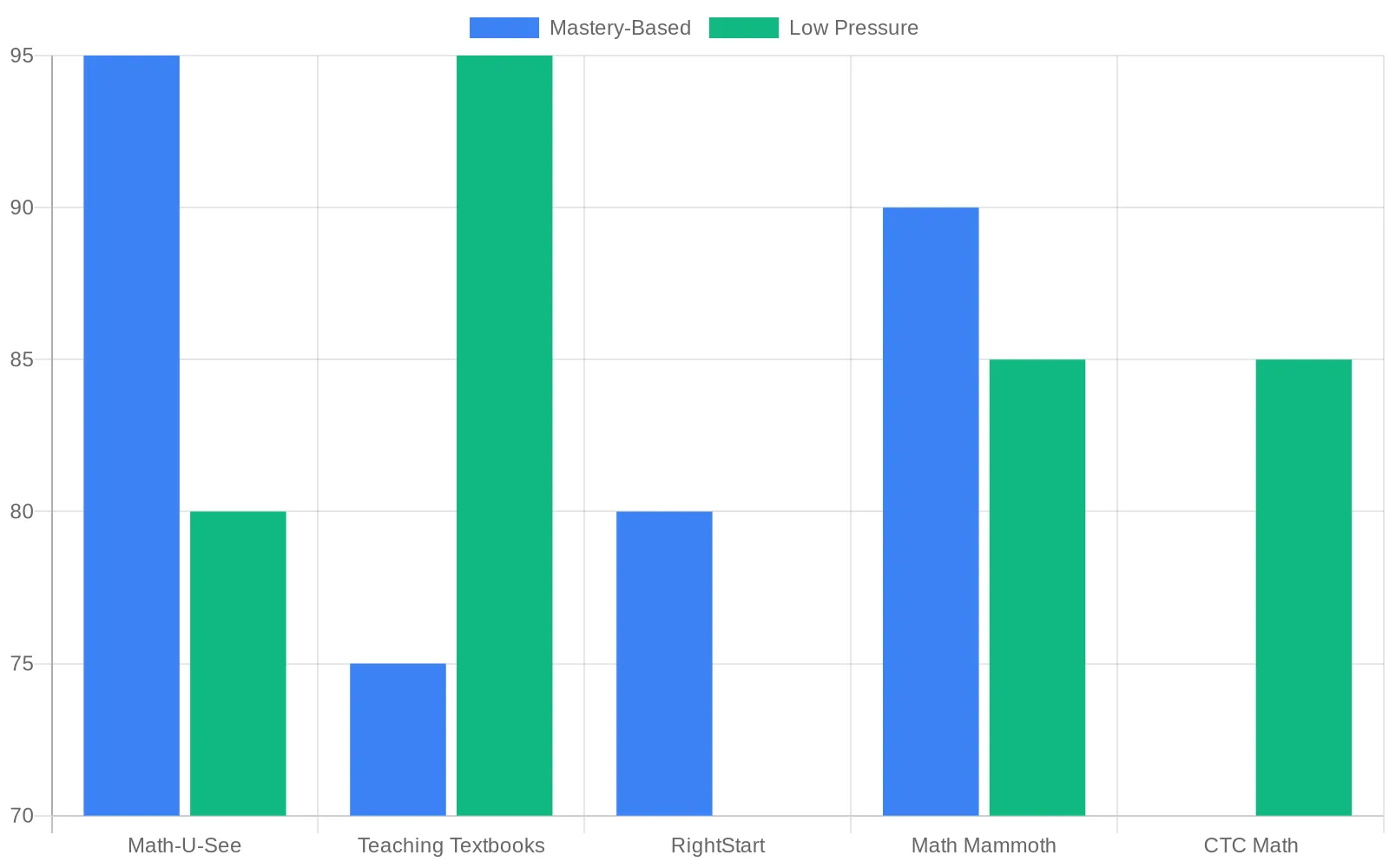
Kids who struggle can’t move on until they truly get it. That’s why mastery-based programs work so well. They let children spend extra time on hard topics. No rushing. No pressure. Spiral programs, in contrast, can overwhelm them with constant new material before they’re ready. To understand this difference better, see our guide on Spiral vs Mastery Math approaches.
Multi-Sensory Instruction
Here’s what research tells us: struggling students learn best through multiple input modes. In other words, they need to see it, hear it, and touch it. Therefore, programs with manipulatives, visual models, and verbal explanations beat textbook-only approaches every time.
The What Works Clearinghouse (part of the U.S. Department of Education) confirms that visual representations improve math learning. Furthermore, studies show that multi-sensory instruction can improve retention by 30-40% for struggling learners.
Patient, Repeatable Explanations
What if your child could replay a lesson ten times? Video lessons offer exactly that—infinite patience. Specifically, the instructor never gets frustrated, never sighs, never rolls their eyes. Consequently, this helps kids with processing differences who simply need more time to absorb information.
Low-Pressure Assessment
Does your child freeze up on tests? High-stakes testing makes anxiety worse and kills performance. Research from Stanford University’s Graduate School of Education shows that math anxiety activates fear centers in the brain, blocking working memory. That’s why programs with second chances work so much better. Untimed practice helps too. And mastery checks feel less scary than traditional tests.
Ability to Move Backwards
What if your sixth-grader missed something in third-grade math? Many struggling students have gaps from previous years. The best curricula let you easily go back and fill those holes—no stigma, no complicated placement tests.
1. Math-U-See: Best Overall for Struggling Students
Why does Math-U-See top our list? Because it tackles the challenges struggling students face head-on. The program combines video instruction, hands-on manipulatives, and mastery-based progression—exactly what these kids need.
Why It Works for Struggling Students
The manipulative blocks make abstract math concrete. First, students physically build numbers. Then, they see place value. Next, they manipulate fractions. Ultimately, this hands-on approach helps concepts “click” for children who’ve struggled with purely abstract instruction.
Moreover, the mastery approach means students don’t move on until they truly understand. If multiplication takes six weeks instead of three, that’s perfectly fine. After using Math-U-See for two years with my youngest, I watched his anxiety transform into genuine confidence. Consequently, this approach removes the pressure that causes math anxiety to spiral.
Mr. Demme’s video lessons are patient and clear. Specifically, he explains concepts multiple ways. As a result, struggling students can rewatch as many times as needed. Parents also watch to learn how to help during practice. In my experience, students often need 2-3 viewings before concepts stick.
What’s Included
- Student workbook and test booklet
- Streaming video instruction
- Integer block manipulative kit
- Teacher manual with solutions
Potential Drawbacks
The manipulative kit costs extra for the first level (about $55). Parent involvement is required. You can’t hand this program to a child and walk away. Some families find the videos dated. However, the instruction remains excellent.
Best For: Children who need to see and touch math. Students with conceptual gaps. Families willing to invest in parent-led instruction.
Price: Universal Set starts at $115 per level. Add $55 for the manipulative kit (first purchase only).
For more details, see our complete Math-U-See Review.
2. Teaching Textbooks: Best for Math Anxiety
Teaching Textbooks offers a different solution. It provides patient video instruction with built-in second chances. This reduces anxiety and builds confidence.
Why It Works for Struggling Students
The “second chance” feature is revolutionary for anxious students. When they get a problem wrong, they can try again. Importantly, it doesn’t affect their grade. As a result, this reduces the fear of mistakes that paralyzes many struggling learners.
Additionally, the animated instructor never gets frustrated. Students can replay explanations indefinitely. They feel no embarrassment. Therefore, this patience is valuable for children who’ve had negative math experiences.
The program handles all teaching and grading automatically. As a result, parents can step back. This often helps children who’ve developed learned helplessness around math. When my middle daughter switched to Teaching Textbooks after years of math struggles, her attitude transformed within three weeks. In fact, fresh instruction from a neutral source can break negative patterns.
What’s Included
- Full online subscription with all lessons
- Animated video instruction for every problem
- Automatic grading with detailed gradebook
- Second-chance option for incorrect answers
- Step-by-step solution videos
Potential Drawbacks
Teaching Textbooks is less rigorous than some alternatives. Students who need advanced math may need to transition to programs like Saxon Math or Singapore Math later. The online-only format requires reliable internet. It also involves more screen time.
Best For: Math-anxious children. Students who need complete independence. Families wanting minimal involvement in math instruction.
Price: $67.96/year per student with annual subscription. $20.08/month for monthly option.
Learn more in our Teaching Textbooks Review. Wondering how it compares to a more rigorous option? See our Teaching Textbooks vs Saxon Math comparison.
3. RightStart Mathematics: Best for Number Sense Gaps
RightStart Mathematics specifically addresses weak number sense. This is a common root cause of math struggles that other programs often ignore.
Why It Works for Struggling Students
Many struggling students never developed strong number sense in early grades. They count on fingers, struggle with mental math, and don’t “see” numbers the way proficient students do. RightStart uses the AL Abacus to build this foundational understanding. When my youngest struggled with mental math in second grade, we spent three months with RightStart’s games. The transformation was remarkable.
Specifically, the abacus helps students visualize quantity relationships. Place value becomes concrete. Addition and multiplication make sense. In other words, these aren’t abstract rules to memorize. Ultimately, this foundation makes all subsequent math easier.
Additionally, RightStart’s game-based practice reduces worksheet fatigue. Card games and activities make practice engaging. As a result, students look forward to math instead of dreading it.
What’s Included
- Teacher manual with scripted lessons
- Student worksheets
- AL Abacus manipulative
- Card games for practice
- Math balance and other manipulatives
Potential Drawbacks
RightStart requires significant parent involvement since lessons are teacher-led rather than independent. The upfront cost runs high, and the approach differs enough from traditional math that students may face an adjustment period if they later transition to other programs.
Best For: Students with weak number sense. Children who struggle with mental math. Families committed to hands-on, game-based learning.
Price: Complete levels start around $240-300 including all materials.
See our detailed RightStart Mathematics Review. For a comparison with another hands-on approach, read our Math-U-See vs RightStart Math guide.
4. Math Mammoth: Best for Filling Specific Gaps
Math Mammoth offers affordable, targeted instruction. It’s perfect for addressing specific areas of weakness. You don’t need to redo entire grade levels.
Why It Works for Struggling Students
Math Mammoth’s Blue Series offers topic-specific workbooks. For instance, does your child struggle only with fractions? If so, you can purchase just the fractions book. Consequently, this targeted approach avoids wasting time on mastered concepts. I’ve used the fractions and decimals books with two of my children to shore up weak spots before moving to pre-algebra.
Furthermore, the workbooks use extensive visual models. Struggling students see what’s happening mathematically. Color-coded examples walk through problems step by step. In addition, many families use Math Mammoth as a supplement. It addresses gaps while using another primary curriculum.
Additionally, the affordable pricing lets you try the approach without major investment. PDF downloads start at just $7 per topic-specific book.
What’s Included
- Worktexts combining instruction and practice
- Answer keys for all problems
- Visual models and diagrams throughout
- Tests and cumulative reviews
- Available as PDF download or printed books
Potential Drawbacks
Math Mammoth is primarily text-based. Therefore, there’s no video instruction. Some struggling students need the multimedia approach of other programs. Additionally, it requires self-direction. No one guides students through the material.
Best For: Students who need to fill specific gaps. Budget-conscious families. Visual learners who work well independently.
Price: Complete grade levels about $40 (PDF). Blue Series topic books $7-15 each.
Read our complete Math Mammoth Review.
5. CTC Math: Best for Self-Paced Remediation
CTC Math provides comprehensive video instruction covering K-12. Struggling students can work at their own pace through any level they need.
Why It Works for Struggling Students
Short video lessons (3-8 minutes) prevent overwhelm. As a result, struggling students focus on one concept at a time. Long lessons don’t lose their attention. Moreover, they can drop back to earlier grade levels whenever needed.
Notably, the family membership covers all grade levels. A struggling fourth-grader can go back to second-grade multiplication. Nobody else needs to know. Therefore, this stigma-free access to lower levels helps students fill gaps without embarrassment. I’ve recommended CTC Math to several families in our co-op who needed this flexibility, and all reported positive results within the first semester.
Furthermore, automatic grading and progress tracking reduce parent workload. Diagnostic tests help identify exactly where students need work.
What’s Included
- Streaming video lessons for all levels K-12
- Practice problems with automatic grading
- Diagnostic assessments to identify gaps
- Progress reports and certificates
- Printable worksheets for additional practice
Potential Drawbacks
CTC Math is entirely video and screen-based, so there are no hands-on manipulatives. Some families mention the instructor’s Australian accent takes getting used to. Practice problem quantity may not be sufficient for students needing extensive repetition either.
Best For: Families needing flexible access across multiple grade levels. Students who work well with video instruction. Homeschools with multiple children at different levels.
Price: Family membership $119/year (all grades, all children). Half-price sales are common.
Check out our full CTC Math Review.
How to Choose the Right Curriculum
With so many options, how do you pick the right one? It comes down to matching the program to your child’s specific needs. Here’s how to do it.
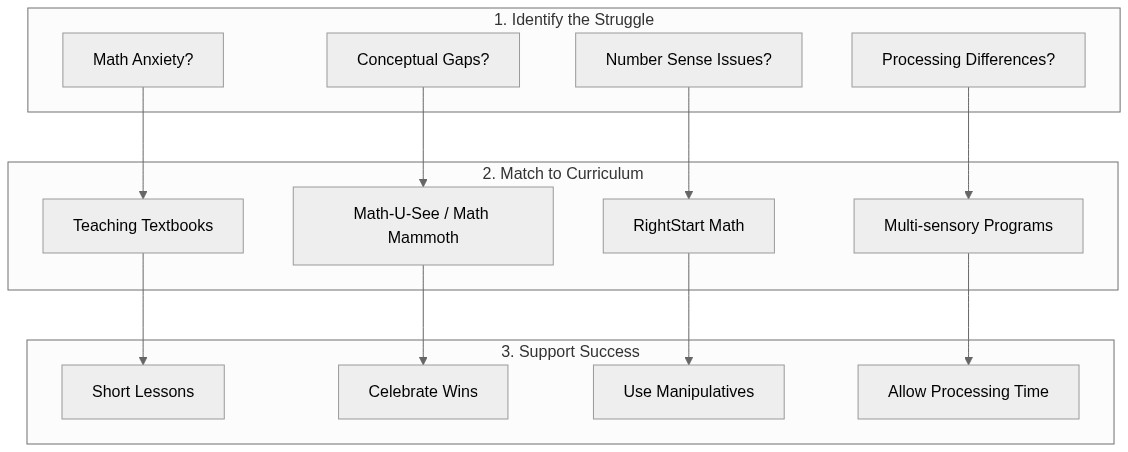
Identify the Root Cause
First, recognize that different causes require different solutions:
- Math anxiety: Choose Teaching Textbooks for low-pressure instruction
- Conceptual gaps: Try Math-U-See or Math Mammoth
- Weak number sense: Consider RightStart Mathematics
- Need for flexibility: CTC Math allows movement between levels
- Processing differences: Math-U-See’s multi-sensory approach often helps
Consider Your Involvement Level
Next, be honest about how much time you can dedicate:
- Minimal involvement: Teaching Textbooks, CTC Math
- Moderate involvement: Math-U-See, Math Mammoth
- High involvement: RightStart Mathematics
Evaluate Placement Carefully
Additionally, always use placement tests when starting a new curriculum. Struggling students often need to start below grade level. This builds solid foundations. Remember, it isn’t failure. Instead, it’s setting them up for success.
Test Before Committing
Finally, most curricula offer free trials or samples. Take advantage of them. Watch how your child responds before purchasing a full program.
Signs the Curriculum Isn’t Working
Even great curricula don’t work for every child. So how do you know when it’s time to try something else? Essentially, watch for these warning signs:
- Continued math avoidance or anxiety after 4-6 weeks
- No progress on fundamental concepts
- Increasing frustration despite your patience
- Difficulty transferring learning to new problems
If you see these signs, don’t force it. Instead, try a different approach. In the long run, this prevents math from becoming more traumatic.
Tips for Teaching Struggling Math Students
Beyond curriculum choice, these strategies help struggling students succeed. I’ve used these techniques with my own children over six years of homeschooling.
Keep Lessons Short
For example, two 15-minute sessions work better than one frustrating hour. Struggling students need breaks before overwhelm sets in. Therefore, watch for signs of fatigue or frustration.
Celebrate Small Wins
Progress for struggling students may be slower. However, that’s okay. Acknowledge every mastered concept. In other words, don’t wait for grade-level achievement to praise effort. When my oldest finally mastered long division after months of work, we celebrated with her favorite dinner. That memory still motivates her through challenging topics.
Use Manipulatives Longer
Don’t rush to abstract calculation. In fact, some children need hands-on materials through middle school. There’s no shame in continued manipulative use. After all, understanding matters more than speed. Once students build confidence, you can explore programs like Beast Academy for more challenge, or Life of Fred for a story-based approach.
Allow Extra Processing Time
Struggling students often know more than they can quickly demonstrate. So, give them time to think. Don’t expect immediate answers. Essentially, patience shows respect for their learning process.
Consider Professional Evaluation
If struggles persist despite appropriate curriculum and instruction, consider evaluation. Testing for dyscalculia or other learning differences can provide clarity. The Understood.org evaluation guide explains how to start the process. Early intervention helps significantly.
Frequently Asked Questions
Should struggling students go back to earlier grade levels?
Yes, usually. Struggling students often have gaps in foundational concepts. Consequently, going back to fill those gaps makes future learning easier. Use placement tests to find the right starting point.
Can struggling students catch up to grade level?
Many can, given appropriate instruction and time. First, build solid foundations. Don’t rush through material. Some students catch up within a year. Others take longer. Ultimately, progress matters more than matching an arbitrary grade level. The goal is confident, capable learners—not arbitrary benchmarks.
Is math tutoring better than a new curriculum?
It depends on the cause of struggles. If the current curriculum doesn’t match your child’s learning style, switching programs may help more. Nevertheless, tutoring can be valuable alongside an appropriate curriculum. This is especially true for students with learning differences.
How do I know if my child has dyscalculia?
Watch for persistent difficulty with number recognition, counting, and basic operations despite plenty of practice. Your child may also struggle to understand quantity relationships. Only a qualified professional can diagnose dyscalculia, though. If you suspect a learning difference, seek evaluation through your school district or a private psychologist.
What if my struggling student eventually needs advanced math?
Start with a supportive curriculum to build confidence and foundations. Then, once your student stabilizes, you can transition to more rigorous programs like those discussed in our Saxon Math vs Singapore Math comparison. Importantly, strong foundations make advanced math more accessible, not less.
Final Recommendations
For most struggling students, Math-U-See provides the best combination of multi-sensory instruction and mastery-based progression. Indeed, the investment in manipulatives pays dividends in understanding.
Alternatively, if math anxiety is the primary issue, Teaching Textbooks offers the low-pressure instruction anxious students need. The second-chance feature alone can transform a child’s relationship with math.
Meanwhile, for students with specific gaps, Math Mammoth provides affordable, targeted instruction. Use it to fill holes while continuing with another primary curriculum.
Whatever you choose, remember that the right curriculum can change everything. For instance, a child who cries over math in one program might thrive in another. I witnessed this transformation in my own home when we switched programs mid-year. Don’t give up. Keep trying until you find what works for your student.
For more options and detailed comparisons, see our Best Homeschool Math Curriculum guide. Also check our article on Best Math Curriculum for Visual Learners, which covers additional options that work well for struggling students who learn visually.



Leave a Reply